
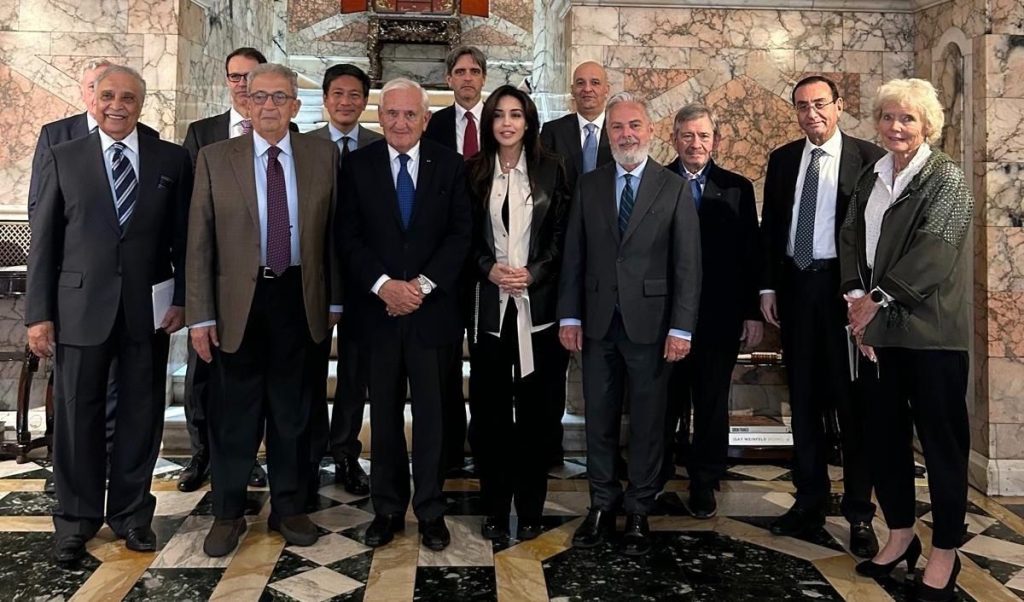
In April, a Leaders for Peace delegation traveled to London at the invitation of H.E. Antonio Patriota, Brazil’s Ambassador to the United Kingdom. The delegation—composed of Donia Kaouach, Jean-Pierre Raffarin, Amre Moussa, Pierre Vimont, Cherif Rahmani, and Elisabeth Decrey-Warner—had the opportunity to discuss the current geopolitical situation, the status of cooperation within Leaders for Peace, and future initiatives. Discussions continued the following day with distinguished guests: Mr. Thant Myint-U, Honorary Fellow of Trinity College, Cambridge, and Senior Fellow of the United Nations Foundation; Jane Kinninmont, Executive Director of the United Nations Association of the United Kingdom; and Alistair Fernie, Executive Director of The Elders. Finally, over lunch, the delegation had the honor of engaging in discussions with Nourredine Yazid, Ambassador of Algeria; Dominique Paravicini, Ambassador of Switzerland; and Ashraf Swelam, Ambassador of Egypt.
Returning to the fundamentals of diplomacy: the need for a renewal of the UN
During the discussions, the Leaders for Peace delegation emphasized the need to return to the fundamentals of diplomacy. In a context marked by the erosion of multilateralism, it appears essential to revive dialogue, both at the international level and within civil society. The delegation also emphasized the importance of reforming the UN to restore respect for international law. These discussions reaffirmed Leaders for Peace’s commitment to strengthening international dialogue and promoting mediation initiatives in response to global conflicts.
Discussions also focused on the election of the future Secretary-General in 2027, as the selection process begins within the New York-based organization. The Leaders for Peace delegation believes that the future Secretary-General must demonstrate a strong sense of history and genuine political courage.
Education for dialogue
While peace education has always been one of the pillars of the Leaders for Peace Foundation, the discussions emphasized that the focus should instead be on education for dialogue. Dialogue is a prerequisite for peace, which cannot be built without genuine discussion. The simple act of demonstrating that dialogue is possible across divides is in itself a political act.
We are extremely grateful to our guests for their insightful reflections. We would also like to express our deep gratitude to Ambassador Patriota for the warm welcome he extended to us at his residence in London.